


Loan origination across banks, NBFCs, and other lending institutions is still deeply document-driven. From KYC and income proofs to bank statements, property papers, and business documents, every loan application brings in a large volume of paperwork, often submitted in mixed formats such as scanned PDFs, photographs, emails, or physical copies.
Processing such lending operations, teams often end up wasting significant time manually reviewing these documents. Data is checked line by line, entered into systems, cross-verified across multiple files, and validated against regulatory requirements. As loan volumes grow, this manual approach starts creating real bottlenecks
This is where AI-powered document management plays a critical role. As such, systems can automatically read, extract, classify, and validate information—directly within the loan origination workflow. It follows a practical workflow to reduce processing delays, improve data accuracy, support regulatory compliance, and allow credit teams to focus on decision-making. But how does AI-powered document management fit into the loan origination process? Let’s talk in detail in this blog.
How Modern Loan Origination Has Redefined Document Management
Loan origination has always been document-heavy! Income proofs, identity records, bank statements, credit reports, collateral papers, and compliance disclosures form the backbone of any lending decision. In traditional environments, these documents process slowly, pass through multiple hands, and often are in disconnected systems.
Modern loan originating software changes this by embedding a centralized document management system that becomes the single source of truth. When AI is layered into this foundation, documents stop being static files and become actionable data assets.
AI-driven document handling enables lenders to:
- Ingest large volumes of borrower data instantly
- Extract and validate information without human intervention
- Identify inconsistencies or risks early in the process
- Maintain audit-ready compliance at all times
How AI Transforms Document Management in Loan Origination
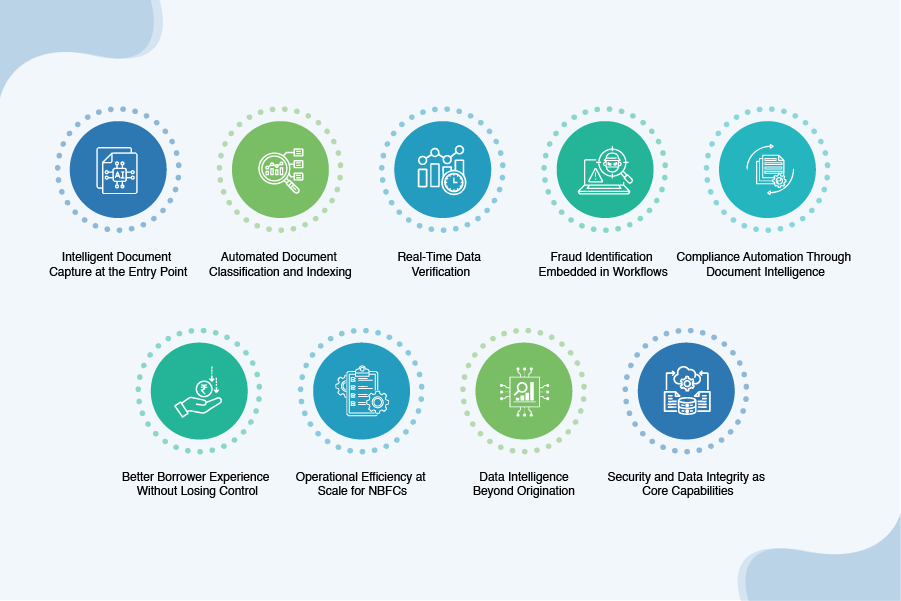
The future of lending is data-driven, automated, and compliance-first. Institutions that continue to rely on fragmented or manual document processes will struggle to compete in an environment shaped by digital lending expectations and regulatory scrutiny. This is because AI is bringing a dynamic shift in the digital lending ecosystem. Here is how:
1. Intelligent Document Capture at the Entry Point
In conventional systems, documents are uploaded and then manually reviewed, renamed, and indexed. AI-powered loan origination management software (LOMS) replaces this with intelligent capture.
Using Optical character recognition (OCR) combined with machine learning AI systems an read documents as soon as they are uploaded—regardless of whether they are PDFs, scanned images, photos, or digitally generated files. This capability allows lenders to process both structured and unstructured documents equally effectively. AI ensures that data is accurately recorded at the initial interaction, whether it is a digitally generated bank statement or a scanned payslip. In digital lending journeys, this directly lowers obstructions and speeds up turnaround times.
2. Automated Document Classification and Indexing
Once documents are captured, AI automatically classifies them (KYC documents, income proofs, bank statements, property papers). Supporting documents are connected to the relevant application, income documents are arranged logically, and identity proofs are appropriately tagged. By eliminating the need for manual sorting, this automation lowers the possibility of missing or incorrectly filed documents.
Automated indexing guarantees consistency across all loan files for lenders utilizing loan originating software across various products and regions. Additionally, it facilitates quicker retrieval for customer inquiries or audits.
3. Real-Time Data Verification
One area where AI is of most apparent value in financial services is real-time verification. This is because it allows for the checking of documents provided by consumers to known sources and verifies their authenticity. Any discrepancies in terms of name, dates, income details, or patterns of transactions can thus be immediately detected.
This capability is particularly critical for loan management software for NBFC, where risk exposure must be tightly controlled without slowing down approvals. AI ensures that speed does not compromise diligence.
4. Fraud Identification Embedded in Workflows
Fraud detection is no longer a separate process. In AI-enabled loan origination solutions, fraud checks are embedded directly into document workflows. Algorithms analyze document patterns, metadata, and behavioral signals to identify potential manipulation or forgery.
By integrating these checks early, lenders reduce downstream losses and protect portfolio quality. This proactive approach strengthens trust in Lending solutions for NBFCs operating in high-volume markets.
5. Compliance Automation Through Document Intelligence
Another challenge that remains complex in the lending business is regulatory compliance. While lending regulatory compliance is intricate, the current approaches for manual compliance checks are even more challenging and time-consuming. AI-based document management solutions are designed to perform constant and automated checks of regulatory compliance.
AI ensures that:
- Mandatory documents are collected before progression
- Expired or invalid documents are flagged automatically
- Regulatory rules are applied consistently across all cases
NBFCs or NBFIs leveraging AI solutions, which means compliance becomes continuous rather than reactive. Every document action is logged, creating a transparent audit trail that satisfies regulators without adding operational overhead.
6. Better Borrower Experience Without Losing Control
Borrower experience is a decisive factor in digital lending adoption. Long document checklists and repeated follow-ups erode trust and increase drop-offs. AI simplifies this experience while preserving lender control.
Smart prompts guide borrowers to upload the right documents at the right time. AI validates submissions instantly, reducing rejections due to simple errors. This balance between automation and accuracy is what differentiates advanced loan originating software from legacy platforms.
7. Operational Efficiency at Scale for NBFCs
Non-banking financial companies operate in diverse customer segments, often with thin margins and high volumes. AI-powered loan management software (LMS) for NBFC enables teams to handle larger portfolios without proportional increases in manpower.
- By automating document handling:
- Processing costs decline significantly
- Approval cycles shorten
- Teams focus on exceptions rather than routine checks
This operational leverage allows NBFCs to expand their lending solutions for NBFCs sustainably while maintaining risk discipline.
8. Data Intelligence Beyond Origination
AI-driven document management does not stop at loan approval. Documents collected during origination continue to deliver value across the loan lifecycle. Structured data feeds into analytics engines, improving credit models, portfolio monitoring, and customer insights.
This continuous intelligence loop strengthens loan origination solutions by turning historical documents into predictive assets. Over time, lenders gain sharper insights into borrower behavior, default risks, and product performance.
9. Security and Data Integrity as Core Capabilities
Data security increasingly becomes important as digitization in lending expands. To protect sensitive data, AI-enabled document management systems incorporate anomaly detection, access controls, and encryption.
This layered security approach ensures that digital scale does not increase vulnerability for financial services organizations implementing AI. Immutable audit logs, real-time monitoring, and restricted access safeguard the organization and its clients.
Final Thoughts
As lending continues to evolve, the emphasis is no longer just on digitizing processes but on making them reliable, compliant, and easier to manage. Loan origination platforms that thoughtfully integrate AI-powered document management, verification, and decision support help reduce operational gaps while improving overall control.
When technology is designed to support, not override, human judgment, it enables lenders to operate more confidently in a complex regulatory and risk environment. In the long run, AI-integrated, practical, and well-balanced documentation management systems will be central to building sustainable digital lending services and experiences.
Hence, as a solution, Lendmantra provides a tested foundation for NBFCs and financial institutions seeking robust, future-ready loan origination solutions, where AI enhances human judgment, documents become strategic assets, and lending decisions are quicker, safer, and more intelligent. Easing documentation management, AI enhances the integrity and accessibility of complex lending document verification, approvals, and overall operations.
Contact our professionals now to enhance your digital lending ecosystem with smarter integrated frameworks!
Read More: https://lendmantra.com/blog/
Frequently Asked Questions:
How does AI improve document processing in the loan origination process?
AI improves document processing by automating tasks that were traditionally manual. It utilizes OCR and machine learning to extract data from documents, identify document types, validate information against predefined rules, and instantly flag inconsistencies. This allows Digital lending platforms to process high volumes of applications quickly without compromising accuracy or control.
How does AI-driven document management reduce manual errors in lending?
Manual errors usually result from repetitive data entry, misclassification, or oversight. AI-driven document management eliminates these risks by standardizing data extraction, enforcing validation rules, and ensuring documents are correctly tagged and linked to each loan file. In loan management software for NBFC, this significantly reduces human dependency and improves overall data integrity.
Can AI help speed up loan approval and disbursement timelines?
Yes. AI accelerates loan approvals by validating documents in real time, detecting issues early, and removing processing bottlenecks. Since verification and compliance checks run automatically within loan origination management software, credit teams can make faster decisions, leading to quicker approvals and shorter disbursement cycles, an essential requirement in competitive Digital lending environments.
How does AI detect missing, duplicate, or fraudulent loan documents?
AI continuously monitors document workflows to ensure completeness and consistency. It identifies missing documents by comparing submissions against mandatory checklists, detects duplicates through pattern and metadata analysis, and flags potential fraud by spotting anomalies, mismatches, or altered content. These capabilities are central to AI in financial services, especially for risk-sensitive lending portfolios.
